



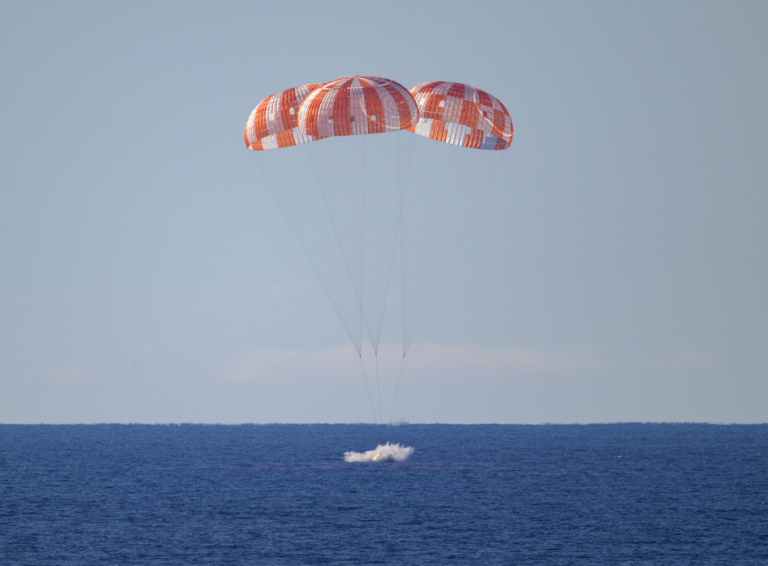
NASA's Orion spacecraft has once again demonstrated its capability as the cornerstone of deep space human exploration, safely returning its crew to Earth with a successful splashdown in the Pacific Ocean off the coast of California and marking the completion of the historic Artemis II mission.
During its nearly 10-day journey, Orion carried astronauts farther from Earth than any human spacecraft in history, traveling more than 695,000 miles, reaching a record 252,756 miles away and completing a precise lunar flyby of the Moon’s far side. Traveling on a free-return trajectory, Orion passed within 4,067 miles of the lunar surface, capturing unprecedented views, conducting critical system tests and demonstrating the spacecraft’s ability to sustain human life in deep space. The crew also experienced a communications blackout as Orion moved behind the Moon and observed a rare solar eclipse from lunar orbit.
As Orion re-entered Earth’s atmosphere at speeds nearing 24,000 mph, its advanced heat shield and parachute system performed as designed, slowing the spacecraft for a safe ocean landing and recovery by NASA and U.S. Navy teams.
This successful splashdown underscores Orion’s role as the only spacecraft capable of carrying humans from Earth to deep space and back, and highlights America’s leadership at the forefront of a new era of exploration. As part of NASA's Artemis program, Orion is paving the way for future missions that will return astronauts to the lunar surface and establish a sustainable presence at the Moon.
Looking ahead, Lockheed Martin and NASA will continue advancing Orion’s capabilities to support upcoming Artemis missions, building on this success to enable deeper exploration, from the Moon to Mars, and ensuring that the United States remains a global leader in human spaceflight for generations to come.
Designed for Deep Space


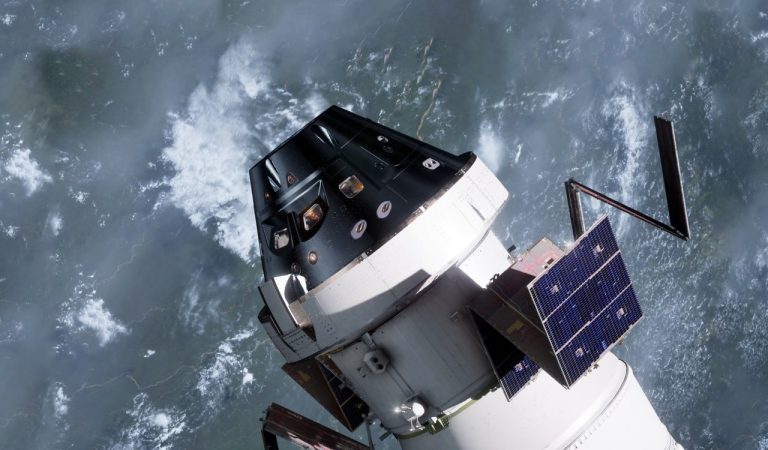
Orion is NASA's spacecraft that will take humans deep into space. No other spacecraft in development has the technology needed for the extremes of deep space, such as life support, navigation, communications, radiation shielding and the world's largest heat shield that will protect astronauts and help return them safely home.
Lockheed Martin is the prime contractor building Orion. We are in the production phase and have finalized a contract for six Orion spacecraft missions and the ability to order up to 12 in total. The first spacecraft delivered on this contract, Artemis III, will carry the first woman and the next man to the surface of the Moon. Orion is a critical part of the agency's Artemis program to build a sustainable presence on the lunar surface and to prepare us to move on to Mars.
What puts Orion in a class all its own? The technology our engineers use to build the only exploration class spacecraft to take humans deeper into space than ever before.
- Life Support Systems: Advanced environmental control and life support systems designed for long duration missions keeps the crew safe and healthy.
- Radiation Protection: Needed to protect crew and spacecraft systems from cosmic and solar radiation seen in deep space.
- Heat Shield: Designed to take extreme temperatures of 5,000°F coming back from the Moon at 24,700 mph, while keeping the crew safe and comfortable.
- Propulsion System: The service module has 33 engines, including its large main engine that is used to provide high-power, deep space maneuvers.
- Deep Space Communications & Navigation: Unique systems designed specifically for deep space travel. Where Orion is going, there are no GPS or communications satellites.
- Redundancy: When coming back home quickly isn’t an option, redundant systems will ensure that critical elements such as computers remain operable if something goes wrong.
People of Orion

Betty pulled from her previous knowledge working NASA's space shuttle to create and deliver the Betty Barrier prototype in one day.

Mark Baldwin is an astronaut safety expert and Lockheed Martin engineer working on the NASA Orion program. We asked him about what it’s like designing systems to protect humans in space.

“The vehicle is like a dart going up in the air. We will see the abort motor kick on as an indication that the abort has started.”
Beyond Orion
